On-site CPR training makes it easier to keep employees certified on the standard two-year renewal…
DOT Drug Test vs. Non-DOT: What Employers Need to Know
Summary
A DOT drug test is federally required under 49 CFR Part 40 for safety-sensitive roles at DOT-regulated employers, with a fixed panel, lab, and review process. Non-DOT testing follows company policy and state law, and sites with both kinds of roles must keep the two programs completely separate.
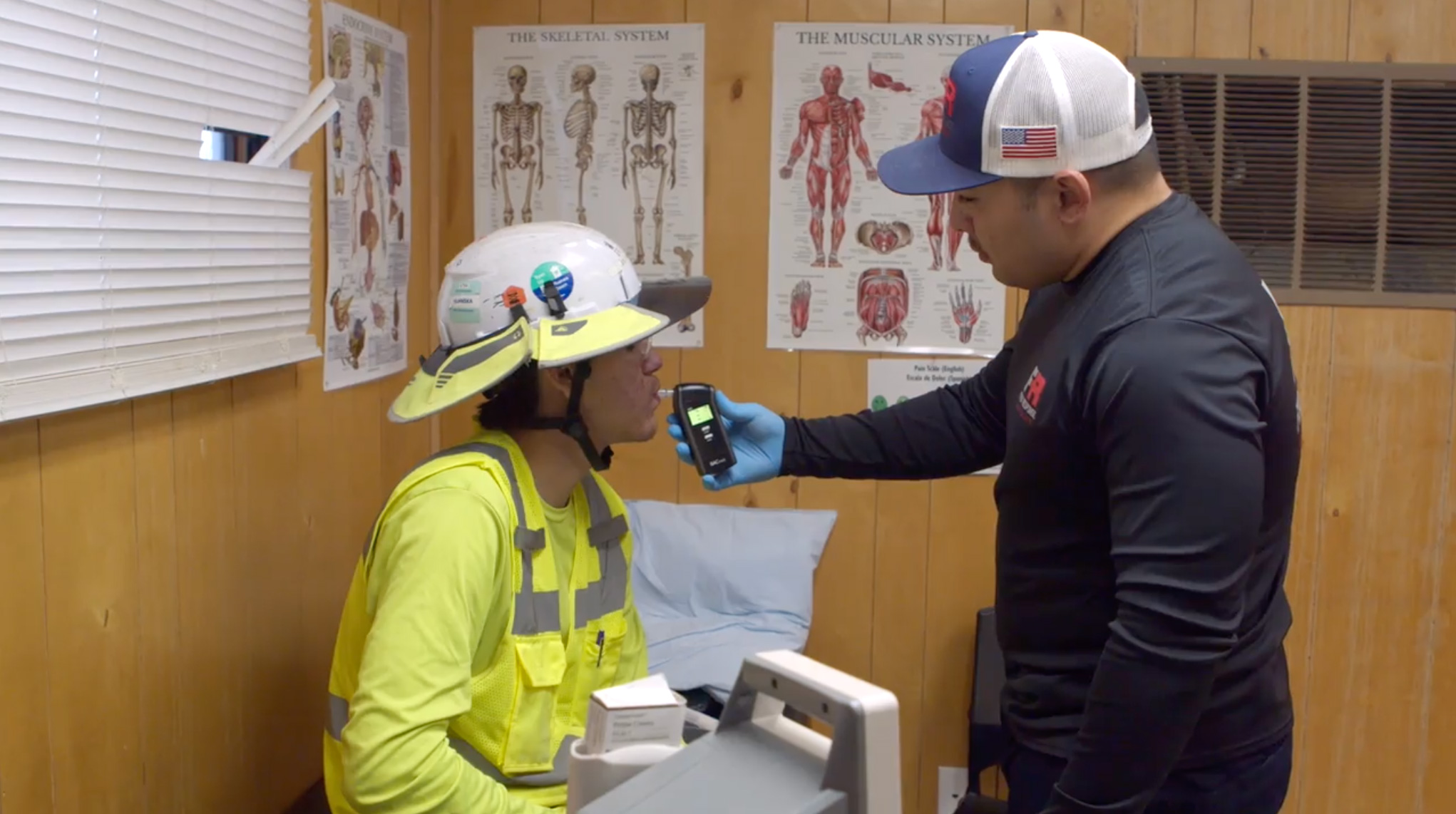
If your company employs CDL drivers alongside general crew, you’ve probably run into two versions of a “drug test”: one with a federal rulebook and one that’s mostly up to you. Confusing the two is one of the more common compliance gaps we see on job sites. First Response Health & Safety runs both DOT and non-DOT drug and alcohol testing on-site. Here’s a breakdown of what differentiates the two tests.
DOT vs. Non-DOT: The Basic Split
A DOT drug test is required under 49 CFR Part 40 for anyone in a “safety-sensitive function” at a DOT-regulated employer:
- Commercial driver’s license (CDL) holders under the Federal Motor Carrier Safety Administration (FMCSA);
- Pilots and aircrew under the Federal Aviation Administration (FAA);
- Freight rail workers under the Federal Railroad Administration (FRA);
- Transit operators under the Federal Transit Administration (FTA);
- Pipeline workers under the Pipeline and Hazardous Materials Safety Administration (PHMSA);
- Merchant mariners under the U.S. Coast Guard (USCG).
None of it is adjustable. The panel, specimen, lab, and review process are all federally fixed: only a Substance Abuse and Mental Health Services Administration (SAMHSA) lab can process a sample, and a Medical Review Officer (MRO) must verify every result. DOT and non-DOT testing must also stay entirely separate, even for the same employee.
Non-DOT testing is everything else: any workplace screening not tied to a DOT-regulated safety-sensitive role, shaped by company policy and whatever state law applies. Employers get to choose the substances tested, the specimen type, and whether to run random testing at all. Most general contractors and industrial employers run a non-DOT program, even when a handful of employees are also subject to DOT testing for driving a commercial motor vehicle (CMV).
DOT Drug Test vs. Non-DOT Drug Test: The Core Differences
Legal Basis
- DOT: Federally mandated, 49 CFR Part 40
- Non-DOT: Employer policy plus state law
Who’s Covered
- DOT: Safety-sensitive roles at DOT-regulated employers
- Non-DOT: Any employer, any role
Drug Panel
- DOT: Fixed 5-panel (expanded effective January 1, 2018 for opioids); can’t add or remove substances
- Non-DOT: Employer’s choice, can narrow or expand
Specimen
- DOT: Urine (oral fluid approved but not yet available, see below)
- Non-DOT: Urine, hair, oral fluid, or blood
Chain of Custody
- DOT: Federal Custody and Control Form, split specimen required
- Non-DOT: Simpler, employer-designed paperwork
Lab and Review
- DOT: SAMHSA-certified lab, mandatory MRO review
- Non-DOT: Employer’s choice
Random Testing
- FMCSA (and several other DOT agencies): Mandatory; 2026 minimum is 50% for drugs, 10% for alcohol
- Non-DOT: Not required
After a Positive
- DOT: Mandatory removal, Substance Abuse Professional (SAP) evaluation, return-to-duty test, minimum six follow-up tests in the first 12 months
- Non-DOT: Determined entirely by company policy
Pending DOT Drug Testing Changes to Watch
Two changes are in progress but not yet usable. Oral fluid (mouth swab) testing was approved as an alternative to urine, but it requires two labs certified by the Department of Health and Human Services (HHS), and none exist yet. Until at least two labs are certified, urine remains the only available specimen type.
Fentanyl still isn’t on the DOT panel. DOT proposed adding it in September 2025, but the rule has not been finalized. Until a final rule is published with an effective date, do not act on this change.
Does a DOT Physical Include a Drug Test?
No. The DOT physical is a distinct medical certification exam checking fitness for the job, performed by a certified medical examiner. It doesn’t include, and can’t substitute for, a DOT drug test. Both are required, as two different appointments.
Non-DOT Testing Still Has to Account for State Law
With no federal rulebook, state marijuana and drug-testing laws fill the non-DOT gap, and vary widely. Here’s how three states compare:
Recreational Marijuana
- Arizona: Legal, Prop 207 (2020)
- California: Legal, Prop 64 (2016)
- Texas: Illegal
Medical Marijuana
- Arizona: Legal, Arizona Medical Marijuana Act (AMMA), 2010
- California: Legal, Prop 215 (1996)
- Texas: Legal, low-THC only (Compassionate Use Program); no employment protection
Off-Duty Use Protection
- Arizona: Cardholders protected unless safety-sensitive, impaired at work, or the employer would lose a federal benefit
- California: Broadest in the country; AB 2188, effective January 1, 2024, bars adverse action for off-duty use and metabolite-only results
- Texas: None; employers have near-total discretion
Construction / Safety-Sensitive Carve-Out
- Arizona: Yes, safety-sensitive roles excluded
- California: Yes, safety-sensitive roles and building/construction trades excluded
- Texas: Not applicable
DOT-Covered Employees
- Arizona: Federal testing applies regardless of any state card
- California: Federal testing applies regardless of any state card
- Texas: Federal testing applies regardless of any state card
The constant: DOT testing works identically in all 50 states. It’s a separate federal mandate, and since marijuana remains a Schedule I substance federally, a Medical Review Officer can’t accept a state card as an explanation for a positive result. Non-DOT policy is where a state-specific look matters.
Which Program Do You Need?
Any employee who drives a CDL-required CMV, or performs a safety-sensitive function under FAA, FRA, FTA, PHMSA, or USCG rules, needs DOT testing. Everyone else typically falls under non-DOT, and many sites need both, kept completely independent. Not sure which roles on your site are safety-sensitive? Our third-party safety professionals can help you get answers before it becomes a compliance gap.
First Response Health & Safety runs on-site DOT and non-DOT drug and alcohol testing nationwide, with DOT-aligned procedures and fast turnaround. Schedule a free consultation to start setting up the program your crew needs.
Related Posts